 EN

What Goes Into a Complete Asphalt Roofing System?
2026/10/19
Learn how shingles, underlayment, starter shingles and ridge caps fit into an asphalt roofing system, plus what to include in a complete purchase inquiry.
Talk to anyone who roofs within a kilometre of the sea and they will tell you the same thing: the tile that looked fine in the catalogue can start to show rust far earlier than expected. It is rarely one cause. Salt lands on the roof and stays there, because sea salt pulls moisture out of the air. The surface stays damp long after the rain stops. In ISO 9223 terms, that is a long time of wetness, and corrosion only moves while the surface is wet.
Wind makes it worse. Coastal rain does not fall straight down. It gets pushed under laps, into valleys, and against flashings. Sun and heat do their own damage in between, drying out adhesives and working fixings loose as the metal expands and contracts. In shaded spots that never quite dry, algae and moss take hold. They do not eat steel on their own, but they hold water against it and hide what is happening underneath.
That is why the first question on a coastal job is not colour or profile. It is exposure. Under ISO 9223, most coastal sites sit in C4 or C5, high or very high corrosivity, with CX kept for splash zones and offshore work. A tile that performs well in a mild inland suburb has not been tested by the same climate, and assuming otherwise is how a roof with a long inland record fails early at the coast.
Stone-coated metal is often described as painted steel. That description misses the whole point. The tile is a stack, and each layer covers for the others. The structure below is also covered in SANER's stone-coated metal roofing guide.
None of this makes the tile indestructible. It makes failure slower and more forgiving, provided the layers stay stuck together. Once granules start coming off in patches, or the top coat cracks, one line of defence is gone and the next one starts carrying the load.
Chloride does not attack a roof evenly. It finds the weak spots, and on a coastal roof those spots are almost always the same.
Site-cut edges come first. A factory edge is coated. A cut made on site is not. The aluminium-zinc coating will protect a short distance in from the cut, but that protection gets used up, and salt air uses it up faster. Ordering the right profiles and accessories so crews cut as little as possible on site is a corrosion decision, even though it looks like a logistics one.
Scratches behave in a similar way. A scratch that only reaches the coating can be lived with while zinc remains. A scratch that reaches bare steel inside a damp lap joint is another matter, because the chemistry inside a tight crevice turns more aggressive than on the open face.
Laps themselves are a trap. Water held between overlapping tiles by capillary action dries slowly, and as it dries the salt in it gets more concentrated. A roof can look dry from the ground while the inside of its laps stays wet for days.
Then there are the fixings. The risk here is not stainless steel itself. For coastal Galvalume work, stainless fasteners are the usual choice, provided the head is isolated with a bonded EPDM washer or a compatible coated or capped head, so the stainless does not sit bare against the panel and water cannot sit in the joint. The real galvanic problems are plain carbon-steel screws, which rust and streak, and copper or lead flashings in direct contact with Galvalume, which can pit the aluminium surface. Fixings should be part of the roofing specification, not something bought separately at the last minute, and no bare penetration should be left open through the weathering surface. For wind-driven rain as well as corrosion, see the comparison of stone-coated metal roof tiles versus asphalt shingles for wind resistance.
Most of the attention goes to the top of the tile. On a humid coast, the underside deserves just as much. Warm, moist air inside the building, or in a humid roof void, condenses on the cooler underside of steel at night. That water is not clean. It carries salts and pollutants, and it sits on steel with no stone granules to protect it.
That is why the roof build-up matters as much as the tile. Underlayment needs to be truly waterproof at laps, valleys and penetrations, not just water resistant on paper. The roof void needs ventilation that actually lets humid air out, rather than sealing it in against cold steel. Battens and counter-battens should leave a path for water to drain and dry, so anything that gets under the tiles can escape instead of pooling. And pitch needs to be at or above the manufacturer's minimum. Below that, wind-driven rain and capillary action will beat the overlaps no matter how good the tile is.
A tile can pass a lab corrosion test and still fail on a real building. The test panel is ventilated and rinsed. A sealed, damp roof void is not.
A supplier who has thought about coastal work will answer these without hesitation. A supplier who only repeats a lifespan number probably has not.
Ask for the base steel thickness and coating mass for the exact profile you are buying, not for the product range in general. Those two numbers do more for coastal life than any brochure claim. Ask what salt-spray testing was done, and to which standard. ASTM B117 is the usual one, but the answer should also say what was measured, time to first red rust or time to a stated percentage of rusted area. Salt-spray hours are a lab ranking. They do not convert neatly into years on a roof, and anyone who turns a thousand hours into a round number of years is doing sales arithmetic, not engineering.
Ask whether ridge caps, valleys, gable trims and flashings use the same coated steel, and how site-cut edges should be treated. Ask what the fixings are made of and whether they are concealed. For coastal sites, that usually means stainless fasteners with bonded EPDM washers and compatible coated or capped heads. Ask for minimum pitch and ventilation requirements in writing for the profile ordered. If the project pitch falls below that minimum, the tile is wrong for the job, whatever the price.
Warranty wording deserves the same care. SANER lists a 30-year product warranty across its range, while stone-coated tiles are described with a longer design lifespan. A warranty and a lifespan are not the same thing. A warranty comes with conditions, and coastal exposure, installation method and maintenance are usually among them. Read those conditions before the container ships, not after the first rust stain shows up. For project bids, also check the certification requirements for stone-coated metal roof tiles in international projects.
Get the coastal specification pack: Send your site's distance from the sea, roof pitch and ventilation setup, and ask SANER for the stone-coated metal roof tiles datasheet, coating and fastener specifications, and a sample in your chosen profile. Contact SANER or write to [email protected], or call +86-15988487144.
Stone-coated metal is low maintenance. It is not maintenance free, and on a coast that distinction is worth money.
Rinse salt off the roof, especially on low pitches and in sheltered areas rain never washes properly. Salt left alone builds up. Salt rinsed off regularly never reaches the concentration that drives fast attack. Keep valleys and gutters clear, because a dam of leaves holds water, and standing water with salt in it is the quickest way to corrode a lap. After a storm, check for displaced tiles, damaged flashings, granule loss where debris hit, and rust staining at cut edges and fixings. Rust at a cut edge early on can be dealt with. Rust that has spread under the granule bed cannot.
Check underneath as well. Staining on underlayment or battens often shows up long before the top surface looks damaged, and it points to condensation or wind-driven water getting in. Once a year is a sensible rhythm for a coastal roof, plus a look after any major storm. Against a roof expected to last decades, that is a small bill.
An honest technical piece should say where its subject does not belong. Stone-coated metal is a poor first choice where seawater regularly splashes the roof, in CX exposure, unless the project has had its own corrosion assessment. It is also the wrong call for an unventilated, low-pitch roof over a permanently humid building, a swimming pool or an unconditioned tropical warehouse, where condensation underneath will dominate whatever happens on top. Copper gutters and flashings draining straight onto steel tiles create another problem that no tile can fix. And if nobody can ever get onto the roof to rinse, inspect or repair it, a system that depends on detailing and periodic checks is not the right system.
In those cases the right answer is a different material, a different detail, or a redesign. It is not a stronger claim in the sales literature.
The layered build is why stone-coated metal earns its place at the coast. Aluminium holds the face, zinc sacrifices itself at damage, acrylic bonds the stone, stone shields the acrylic, and a top coat seals the lot. One defect does not have to become a failure, because another layer is behind it. But that only holds on a roof that was specified as a system, with the right exposure class, treated cut edges, compatible fixings, ventilation, pitch and a maintenance plan someone will actually follow.
Buy the system, not just the tile. Ask for numbers with a standard attached. And be wary of any supplier who promises coastal performance without asking how far the site is from the sea, which way the wind blows, what the pitch is, and how the roof will be ventilated. If they have not asked those questions, they have not understood the climate the roof has to live in.
About SANER: Hangzhou Saner Roofing Building Materials Co., Ltd. (SANER) is a Hangzhou-based factory producing asphalt shingles, stone-coated metal roof tiles, PVC vinyl siding, fiber-cement siding and roofing accessories, exported to more than 55 countries and regions. The company offers OEM/ODM customization and a 30-year product warranty. For project-specific coastal specifications, samples, and technical data, contact +86-15988487144 or [email protected], or visit www.sanerbuild.com.

2026/10/19
Learn how shingles, underlayment, starter shingles and ridge caps fit into an asphalt roofing system, plus what to include in a complete purchase inquiry.
2026/10/09
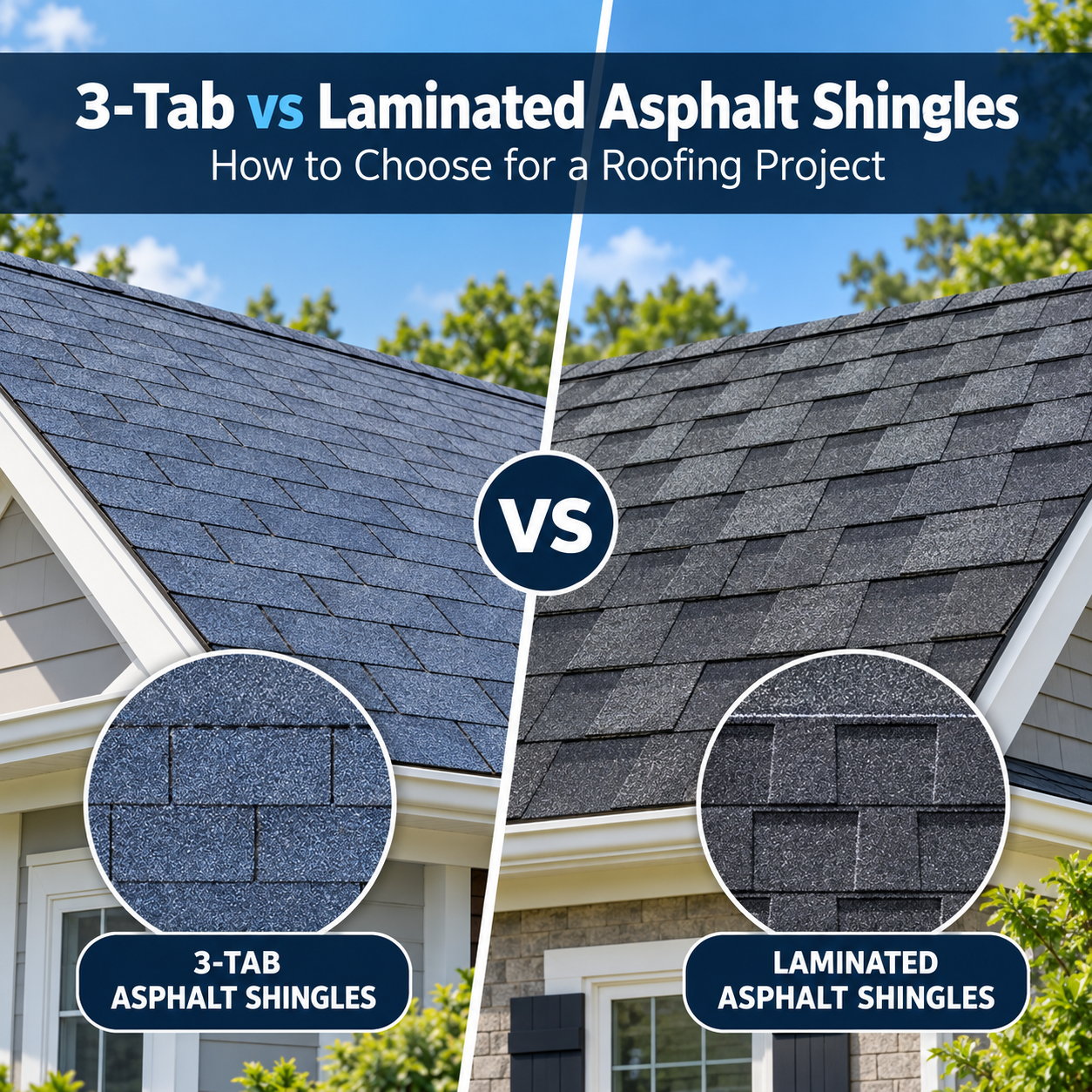
Compare 3-tab and laminated asphalt shingles by appearance, roof layout, accessories and purchasing requirements. Learn what to ask before requesting a quote.
2026/09/23
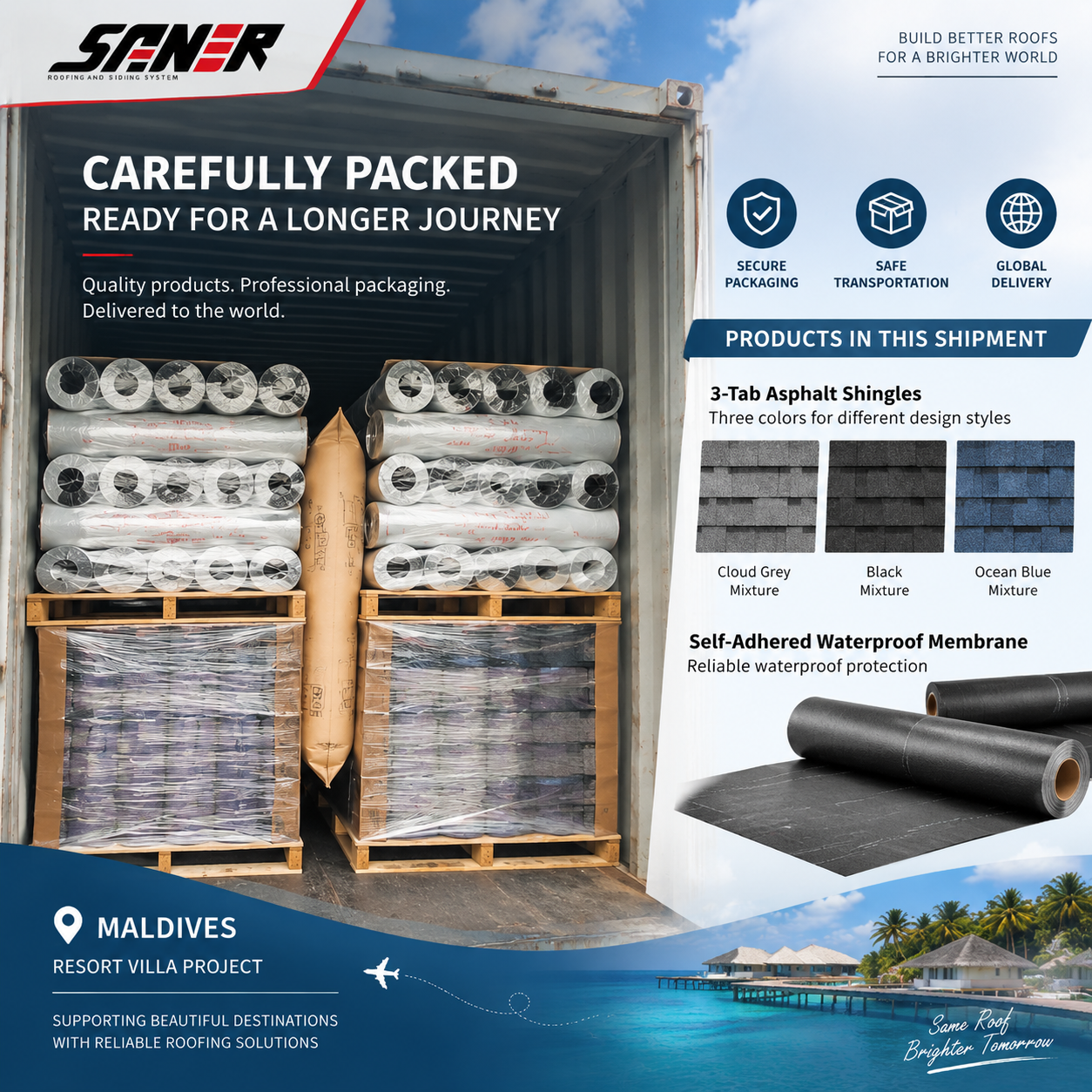
SANER supplied 3-Tab Asphalt Shingles and Self-Adhered Waterproof Membrane for a Maldives resort villa project, providing reliable roofing solutions for tropical environments.
2026/09/17
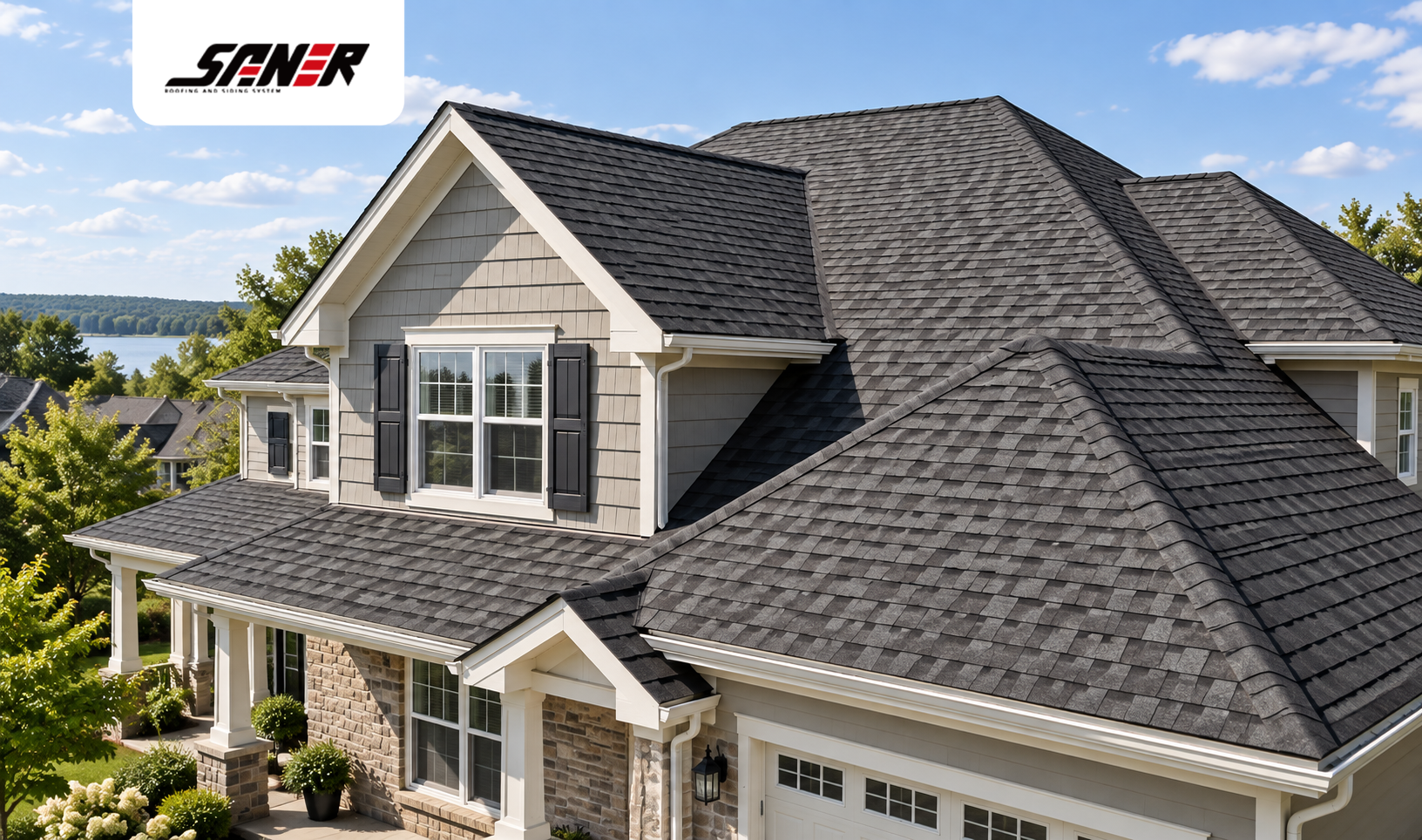
How long do asphalt shingles really last? Learn why climate, ventilation, installation and roof design can make a 30-year reference very different in real life.

2026/09/09
New U.S. tariffs on selected Canadian building materials are changing sourcing decisions. See what this means for distributors, importers and global suppliers.
