 EN
EN

Asphalt Shingle Lifespan: What Really Determines How Long a Roof Lasts?
2026/09/17
How long do asphalt shingles really last? Learn why climate, ventilation, installation and roof design can make a 30-year reference very different in real life.
2026/09/09
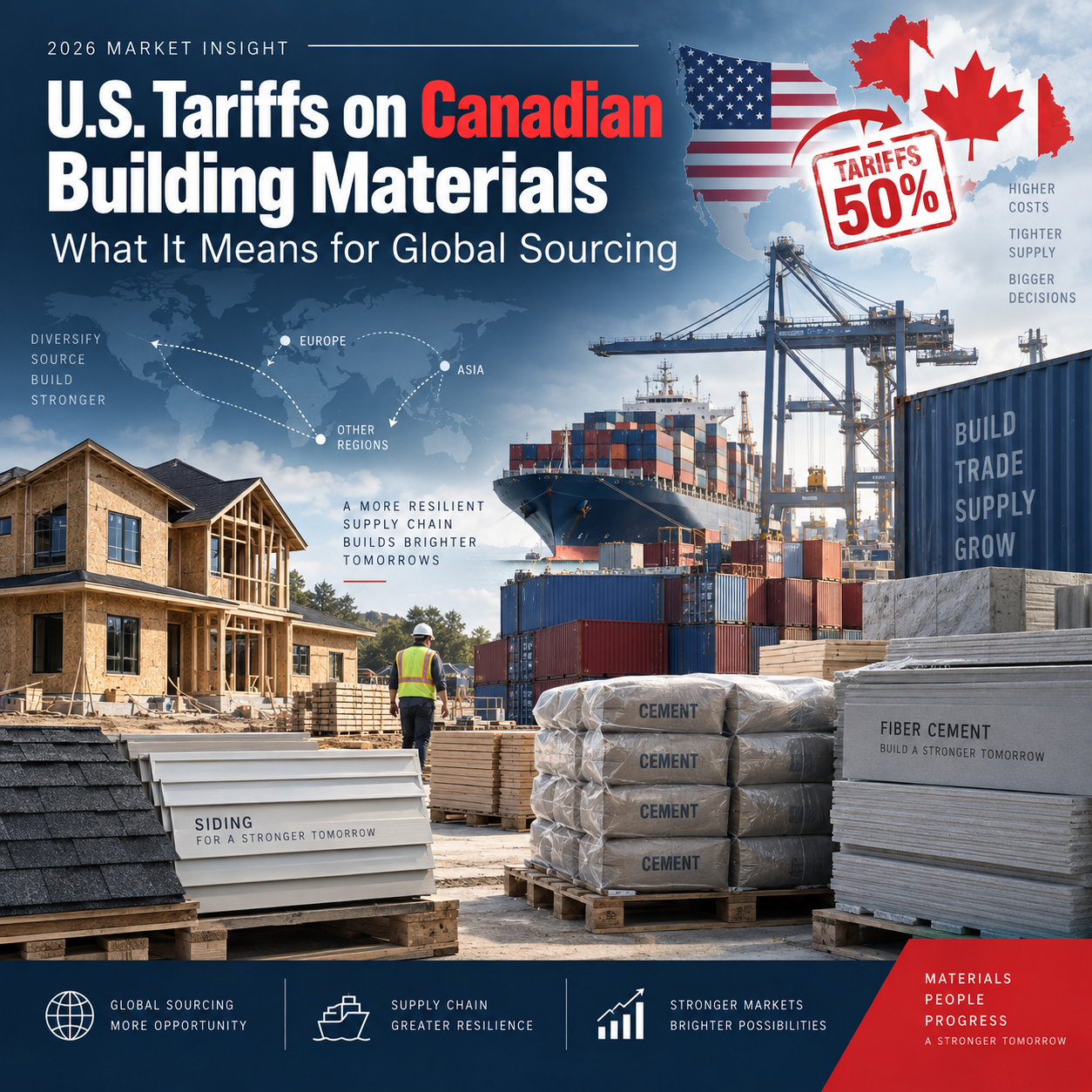
The latest round of U.S. tariffs on Canadian goods has added another layer of uncertainty to the North American building materials market.
In 2026, the United States introduced additional 50% tariffs on certain Canadian products, including cement and a number of building-material categories. The measures affect selected goods rather than every Canadian construction product, but the message to the market is broader: even long-established regional supply chains can change quickly when trade policy shifts.
For contractors, distributors and importers, the immediate question is not simply whether Canadian products will become more expensive.
The more important question is:
Will buyers continue sourcing the same way?
Construction demand does not disappear because one country becomes more expensive to buy from.
Builders still need roofing materials.
Distributors still need siding.
Contractors still need cement, panels, boards and exterior products.
What changes is the sourcing calculation.
A product that once made sense because of proximity, established logistics and low trade friction may suddenly become less competitive after tariffs are added.
That does not necessarily mean the buyer will stop purchasing the product category.
It often means the buyer starts comparing alternative supply sources.
This is where trade policy begins to affect procurement behavior.
In building materials, purchasing decisions should never be made on product price alone.
The real cost includes:
A supplier with a lower FOB price is not automatically the lowest-cost option once the material reaches the distributor's warehouse.
The current U.S.-Canada tariff situation makes this point especially clear.
When an additional 50% tariff is applied to a covered Canadian product, buyers naturally begin asking whether alternative sources can provide a more stable total cost.
This creates an opportunity for suppliers outside North America, but only if they can compete on more than price.
The direct impact varies by product category.
For PVC vinyl siding and fiber cement siding, the opportunity may be more visible because the current tariff discussion is closely connected to construction materials and exterior building products.
U.S. distributors that rely heavily on Canadian supply may become more willing to evaluate alternative manufacturers, especially if they are looking to reduce exposure to sudden tariff changes.
For asphalt shingles, the effect is more indirect.
The current tariff measures are not simply a blanket tariff on all Canadian roofing products. However, once distributors begin reviewing their broader building-material supply chains, roofing products may also become part of the conversation.
Stone-coated metal roofing requires even more careful analysis.
Metal products can be affected by separate U.S. tariff programs related to steel and aluminum, which means any sourcing decision must be based on the full tariff structure, not just the new Canada-specific measures.
One of the biggest lessons from recent trade policy changes is that supply-chain concentration carries risk.
For years, many North American buyers relied heavily on suppliers within the United States, Canada and Mexico because the regional supply chain was relatively predictable.
That assumption is becoming less secure.
A distributor may now ask:
What happens if my primary supplier is affected by a new tariff?
What happens if import costs change again?
What happens if one region becomes temporarily less competitive?
This is why secondary sourcing is becoming increasingly important.
An overseas supplier does not always need to replace the existing supplier completely.
In many cases, the first step is simply to become a qualified second source.
That gives the buyer more flexibility, more negotiating power and a backup option when trade conditions change.
For distributors, relying on a single supplier may appear efficient when the market is stable.
But when tariffs, freight costs and trade rules change quickly, that same concentration can become a weakness.
A second-source strategy allows buyers to diversify supply without immediately changing their entire procurement structure.
For roofing and siding distributors, this can mean qualifying an alternative manufacturer for selected products, colors or specifications.
If market conditions change, the buyer already has another approved option.
That can be more valuable than trying to find a new supplier after a disruption has already happened.
It would be a mistake to assume that higher tariffs on Canadian goods automatically make products from other countries more competitive.
Every product has its own tariff classification.
Some materials may face additional duties, anti-dumping measures or other trade restrictions depending on origin and product type.
Metal roofing products, for example, need to be reviewed carefully because steel and aluminum policies can materially affect import cost.
That means international suppliers need to understand the buyer's total landed cost rather than simply promoting a low factory price.
The strongest suppliers will be those that can explain:
In a more complicated trade environment, transparency becomes a competitive advantage.
The most important effect of the latest tariffs may not be the tariff itself.
It may be the change in purchasing behavior that follows.
When buyers are forced to recalculate costs, they also begin to question old assumptions.
Is the current supplier still the best option?
Should we qualify another source?
Can we reduce dependence on one region?
Can we improve total landed cost through a different supply structure?
These questions create opportunities for new suppliers to enter conversations that may previously have been closed.
For manufacturers outside North America, the opportunity is not simply to say:
"Our product is cheaper."
A stronger message is:
"We can provide an additional sourcing option with stable specifications, predictable supply and controlled total cost."
That is a much more useful value proposition in the current market.
The latest U.S. tariffs on selected Canadian building materials should not be seen only as a pricing event.
They are part of a broader shift in global procurement.
Construction materials are becoming more sensitive to trade policy, and buyers are placing greater value on sourcing flexibility.
Demand will continue.
What may change is where that demand is supplied from.
For roofing and siding distributors, this is a good time to review supply-chain concentration and evaluate qualified alternative sources before another market change forces the decision.
For manufacturers, the opportunity is clear: not just to compete on price, but to become a reliable part of a more diversified supply chain.

2026/09/17
How long do asphalt shingles really last? Learn why climate, ventilation, installation and roof design can make a 30-year reference very different in real life.

2026/09/03
The SANER team recently enjoyed a team-building night with dinner and karaoke, bringing colleagues together outside the workplace for a relaxed evening.
2026/09/01
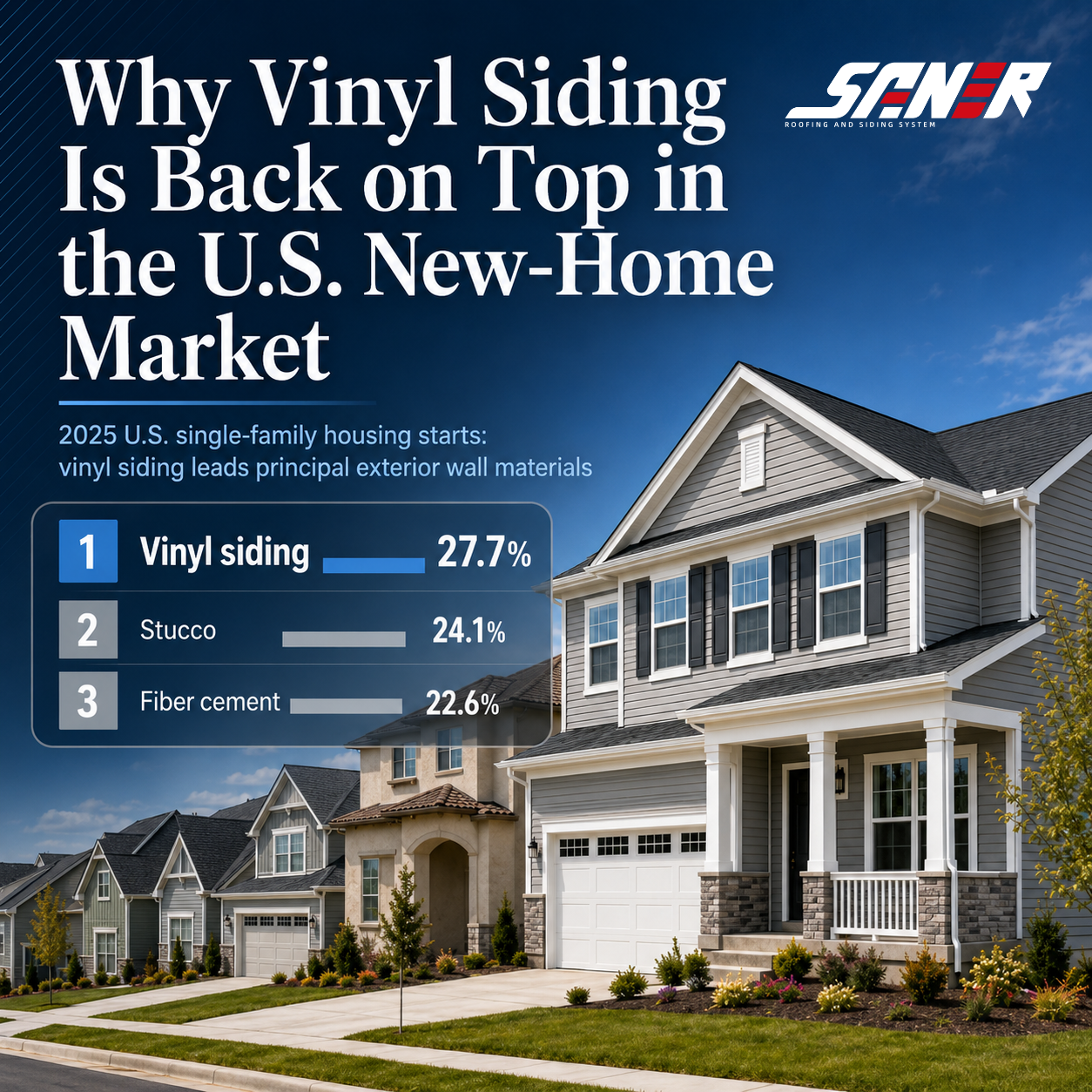
Vinyl siding accounted for 27.7% of U.S. single-family homes started in 2025. Discover why cost, installation efficiency and regional demand are driving its return in 2026.

2026/08/26
Indian customer visits Saner factory in China to explore roofing materials, production capabilities, quality control and future cooperation.
2026/09/01
Discover key insights on roofing shingles from SANER, including benefits, pricing, and performance tips.
